Staedtler Ames Lettering Guide Review (2026)
Updated September 21, 2026 · Research-based review
Our verdict
The Staedtler Ames Lettering Guide is a plastic drafting tool that rules evenly spaced guidelines from about 1/16 to 2 inches tall directly onto your paper. Letterers who want quick, precise, repeatable guides for varied letter heights will get real use from it, though it needs a straightedge and a little trial and error to learn.
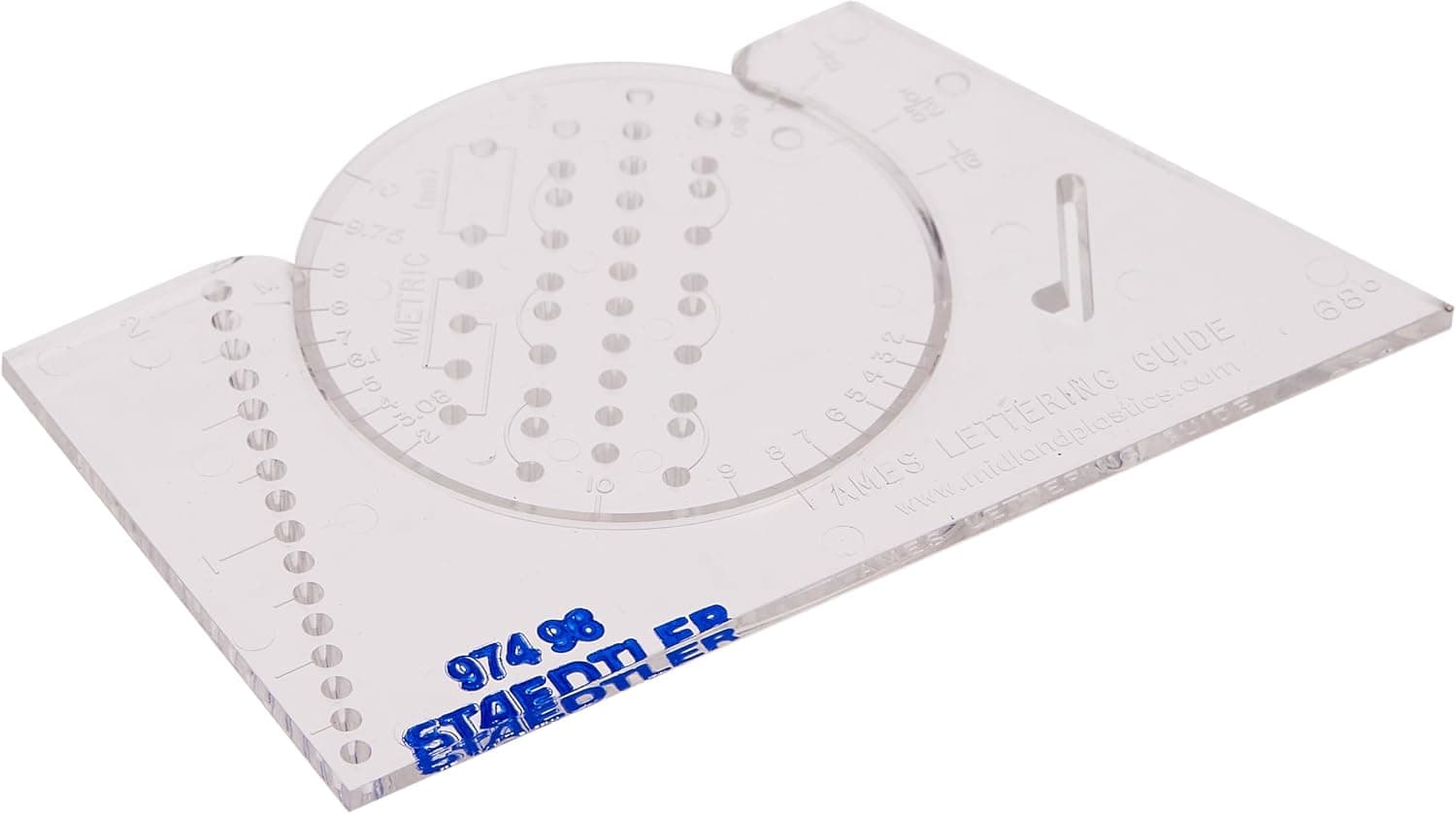
Staedtler Ames lettering guide, a drafting classic for ruling evenly spaced guidelines on any paper.
Price range: See on Amazon
What we liked
- + Staedtler brand quality gives confidence in the scale markings
- + Adjustable disc sets ascender, x-height and descender spacing
- + Lets you rule guides directly onto final paper for projects
Trade-offs
- - Instructions are minimal, so beginners may need a tutorial
- - Must be paired with a straightedge for proper use
A drafting classic adapted for lettering
The Ames Lettering Guide, item number 974 98 in Staedtler's lineup, is a small, durable plastic disk tool originally designed for drafters, architects, and engineers to rule consistent guidelines by hand. It has found a lasting second life among calligraphers and hand letterers, who use it for the same purpose: drawing evenly spaced horizontal guidelines directly onto working paper before adding ink. The guide is built around a rotating inner disk with an indexed rim, calibrated in both fractional and metric increments, set inside a flat plastic body with a series of holes positioned around its edge. Because it produces guides on the actual sheet being used for a finished piece, rather than a separate template placed underneath, it is especially useful for calligraphers working on cardstock, envelopes, or other paper too thick or opaque to see guides through from below.
How it sets up letter heights
To use the guide, you rotate the disk to select a spacing setting, which controls how far apart the ruled lines will fall, corresponding to letter heights described as ranging from about 1/16 inch up to 2 inches. With the disk set, you slide the tool along a straightedge, dropping a pencil point into one of the holes around the edge and marking a line at each position as you move the guide across the page. The manufacturer's description notes the whole process can take as little as about 15 seconds once the technique is familiar, producing a full set of guidelines, including ascender, x-height, and descender lines, in one pass rather than measuring and marking each line by hand.
A tool that rewards a short learning curve
Because the guide relies on rotating a small disk to a specific setting and then tracking a pencil through a series of holes while sliding along a ruler, it takes a bit of practice to use smoothly, and the instructions that come with it are fairly minimal. New users may want to look up a tutorial or diagram showing how the disk settings correspond to specific letter heights and line spacing before relying on it for a final piece, rather than guessing through trial and error on good paper. Once the technique clicks, though, it becomes a fast way to rule consistent guides repeatedly, which is harder to do by hand with just a ruler and a lot of small measurements.
What else you need
The Ames guide is not a standalone ruler; it must be paired with a separate straightedge, since the tool itself only tracks vertical spacing through its disk and holes rather than providing a long edge to slide along. Calligraphers who do not already have a metal or clear plastic ruler on hand will need to add one to make full use of the guide. Beyond that, it is a compact, pocket sized tool that does not require batteries, cords, or any setup beyond understanding how the disk correlates to the desired letter height, and it is a Staedtler product, a brand widely used and trusted in drafting and technical drawing circles.
Who should buy this guide
This tool suits calligraphers and hand letterers who want to rule precise, repeatable guidelines directly on their working paper for varying letter heights, rather than relying on printed templates seen through the page. It is a particularly good fit for anyone who already does some drafting or technical drawing and is comfortable with tools that require a bit of practice to master. Letterers who want an instant, no learning curve solution, or who primarily work from printed guide sheets placed underneath translucent paper, may find a simpler ruled template easier to pick up.
Frequently asked questions
What letter heights can this guide create?
Staedtler describes the range as roughly 1/16 inch up to 2 inches, adjustable using the tool's rotating, indexed disk.
Do I need anything else to use it?
Yes, you need a separate straightedge to slide the guide along while marking lines through its holes with a pencil.
Is this guide hard to learn?
It has a short learning curve since the included instructions are minimal, so many users look up a tutorial to understand how the disk settings correspond to specific letter heights before using it on a final project.
Can I use it directly on my final paper?
Yes, since it rules guidelines directly onto the sheet you are working on, useful for cardstock or other paper too opaque to see a guide through from underneath.
Prices change often, so check the current price and availability on Amazon.
Check price on AmazonCalligraphy Nest may earn a commission from the link above.