Pacific Arc Ames Lettering Guide for Lettering, Writing, Architecture, and Drawing Review (2026)
Updated September 20, 2026 · Research-based review
Our verdict
The Pacific Arc Ames lettering guide is a classic drafting tool that dials in x-height and line spacing on a rotating disc, letting letterers rule guidelines for many sizes without printing separate templates. It has a learning curve to read the disc settings correctly and still needs a T-square or straightedge to actually draw the lines.
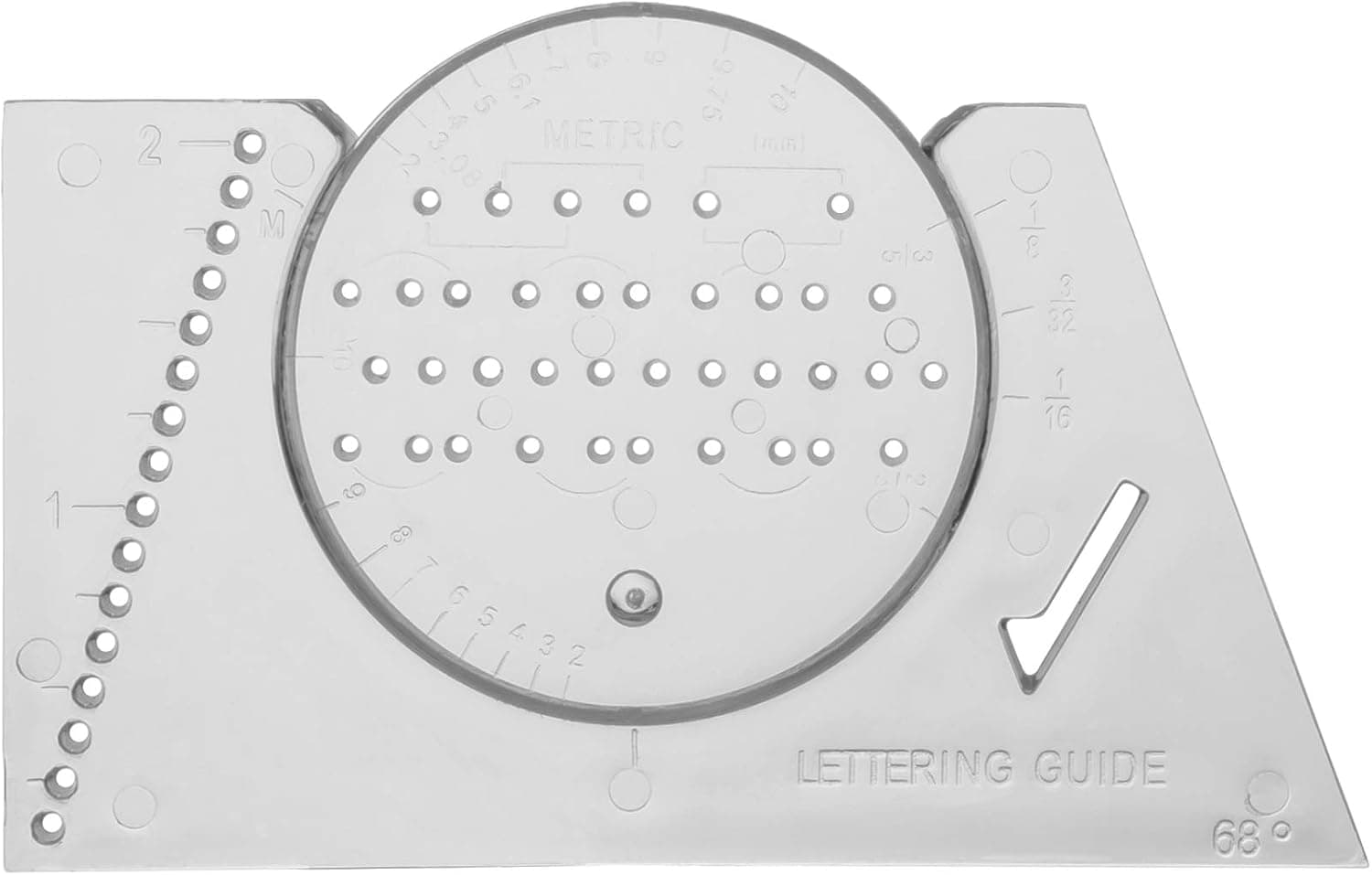
Pacific Arc Ames lettering guide for ruling consistent guidelines in lettering, writing, architecture and drawing.
Price range: See on Amazon
What we liked
- + Rotating disc sets many x-height and line spacing combinations
- + Classic drafting tool that saves printing custom guide sheets
- + Works on any paper, including cardstock and envelopes
Trade-offs
- - Takes practice to learn how to read the disc settings
- - Needs a T-square or straightedge to rule accurate lines
What this tool is
This is Pacific Arc's version of the Ames lettering guide, a classic transparent plastic drafting instrument built around a rotating disc set inside a fixed body with a row of small holes. The disc is marked with a numbered index that corresponds to different letter heights and line spacings, and turning it to a chosen number lines up a set of holes at the correct vertical spacing for that size. The body includes a straight edge, with reference markings at 6 and 10 inches for quick measuring, along with both English and metric spacing options, and the tool is stenciled with a check mark symbol useful for marking off completed items on a checklist alongside lettering work.
How it performs for lettering
To use the guide, you rest it against a T-square or any straightedge and slide it left or right while inserting a pencil tip into the holes in sequence, which marks a series of evenly spaced dots or short lines across the page; connecting those marks with the straightedge produces perfectly parallel guidelines at whatever spacing the disc is set to. This is especially useful for letterers who want consistent guideline sets for multiple projects at different sizes without printing and re-printing guide sheets from a computer, since the tool can be reset to a new spacing in seconds. According to the manufacturer, the guide also supports equal 1/8 inch spacing for headline lettering and a built-in ratio where lowercase letters are set at three-fifths the height of capitals, a traditional lettering proportion useful for anyone ruling guides for mixed-case display lettering.
Learning curve and requirements
The Ames guide is a well established tool among drafters and letterers, but it is not immediately intuitive: reading the numbered disc correctly and understanding which row of holes corresponds to baseline, waistline, cap-height and descender guides takes some practice and often a quick look at a reference diagram the first few times. It is also not a standalone ruler: the guide only marks points, so a T-square, ruler or other straightedge is required to connect those points into usable lines, meaning it works best as part of a small drafting kit rather than the only tool needed on a desk. Buyers used to printed guide sheets should expect an adjustment period switching to a manual marking tool like this one.
Materials and durability
The guide is made of durable, unbreakable plastic that is transparent, so a letterer can see the paper and any existing marks underneath while positioning the tool, an important detail for lining up guides accurately on a page that may already have other markings. Its flat, thin profile means it stores easily in a drawer, pencil case or flat file alongside rulers and other drafting tools without taking up much space. As a classic drafting instrument still produced today, the design has changed little over decades, which speaks to its durability and continued usefulness for both traditional drafting and hand lettering.
Value for letterers
For a low-cost plastic tool, the Ames guide offers genuine flexibility that a single printed guide sheet cannot match, since one physical tool can produce guidelines at many different heights and spacings rather than being locked to whatever was printed on a page. It particularly suits letterers who work across a range of projects and sizes, from small envelope addressing to larger display lettering, without wanting to keep a stack of printed templates on hand. Buyers who only ever letter at one fixed size, or who prefer printed guide sheets they can trace directly without a separate marking step, may find the manual process less convenient, but for varied lettering work the low price and reusability make it a solid value.
Frequently asked questions
How do you use an Ames lettering guide?
You set the disc to a numbered spacing, rest the guide against a T-square or straightedge, and slide it while marking points through the holes, then connect the points into lines.
Do I still need a ruler with this tool?
Yes, the guide only marks evenly spaced points; you need a T-square or straightedge to connect them into actual guidelines.
What letter heights can this guide set?
The manufacturer states it can produce guidelines for letters roughly from 1/16 inch up to 1.5 inches in height, in both English and metric spacing.
Is the Ames guide hard to learn?
It takes some practice to read the numbered disc and understand which holes correspond to which guideline, but it becomes quick to use once familiar.
Prices change often, so check the current price and availability on Amazon.
Check price on AmazonCalligraphy Nest may earn a commission from the link above.