Faber-Castell Kneadable Eraser for Artists in Storage Case - Absorbent Kneaded Eraser, Grey Review (2026)
Updated September 21, 2026 · Research-based review
Our verdict
Faber-Castell's grey kneaded eraser ships in a snap shut plastic case and is made from PVC and latex free material for lifting pencil guidelines without scrubbing the paper. It handles light pencil marks between letters well, but struggles with heavy dark pencil and eventually needs replacing as it absorbs graphite.
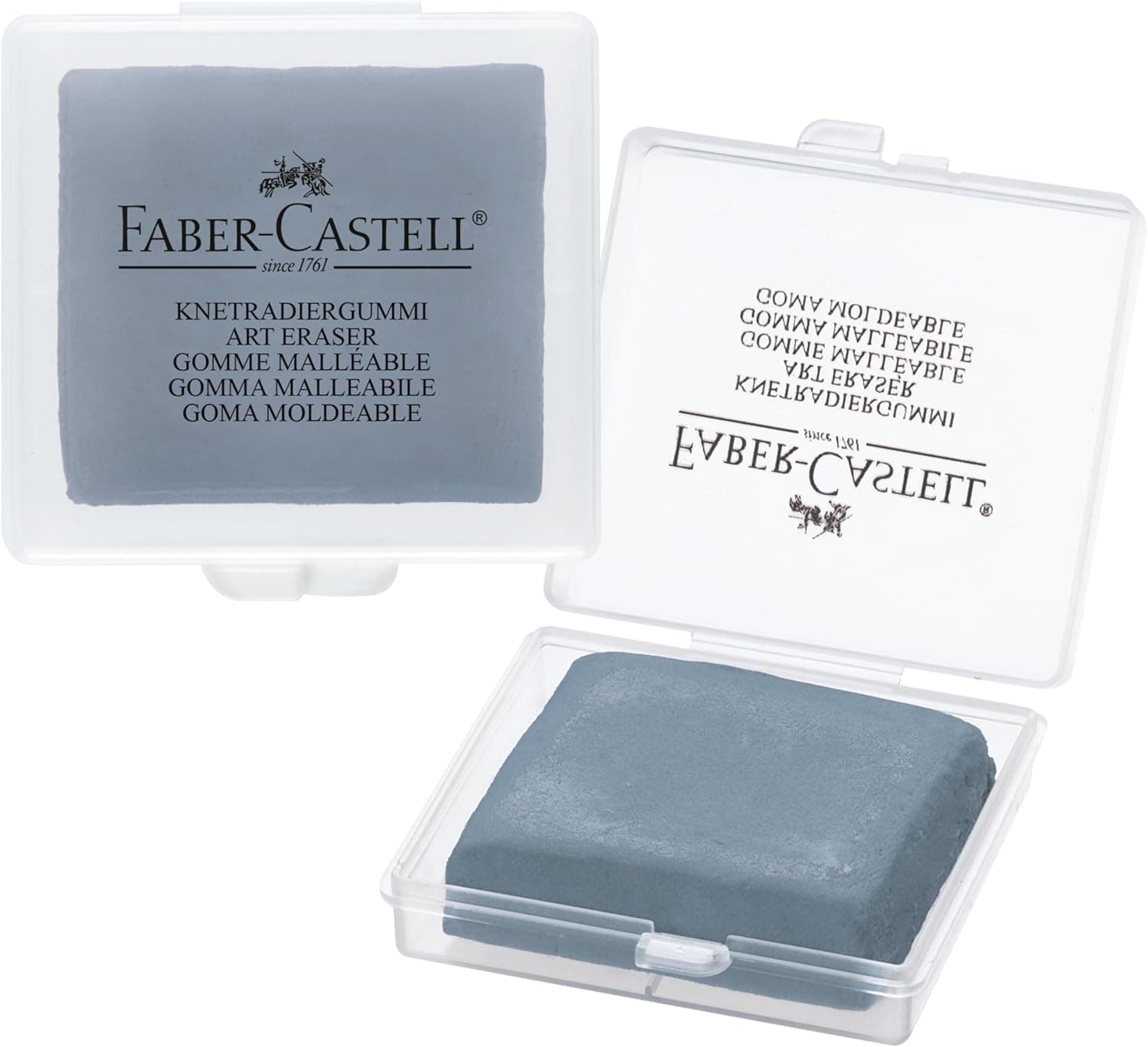
Faber-Castell grey kneadable eraser in a storage case, an absorbent kneaded eraser for lifting pencil guidelines.
Price range: See on Amazon
What we liked
- + Kneaded eraser lifts graphite without scrubbing delicate paper
- + Storage case keeps the eraser clean and free of dust and lint
- + Can be shaped to a point to remove guide lines between letters
Trade-offs
- - Kneaded erasers struggle with heavy dark pencil marks
- - Absorbs graphite over time and eventually needs replacing
A moldable eraser built for artists
This is Faber-Castell's kneadable, or kneaded, eraser, item number FC127220, made from a PVC and latex free material rather than the harder rubber used in standard pencil erasers. It ships as a single eraser in a grey color, packaged inside a sturdy plastic storage case with a snap closure, sized at roughly two inches square, small enough to toss into a pencil case or supply kit without taking up much room. Faber-Castell markets it for correcting, lightening, and cleaning charcoal, pencil, and pastel drawings, as well as for cleaning acetate film, slides, and layouts, reflecting its traditional use across drawing and design work generally rather than being built specifically for lettering.
Why kneaded erasers suit lettering guidelines
For calligraphy and hand lettering, the main use for a kneaded eraser is lifting pencil guidelines after inking is finished, without disturbing the ink itself or roughing up the paper surface the way a harder, rubber eraser can. Because the material is soft and moldable, it can be pinched, stretched, and reshaped by hand, letting you form a fine point or edge to erase small guide marks between individual letters without smudging the surrounding ink. Rather than scrubbing across the page, a kneaded eraser lifts graphite by dabbing or gently pressing it against the pencil marks, gentler on delicate or textured papers that a standard eraser could tear or burnish.
Where it falls short
Kneaded erasers are absorbent by design, part of what makes them gentle, but that same trait means they are not well suited to heavy, dark pencil marks or large areas of shading, since they lift graphite gradually rather than removing it in one pass the way a firmer eraser can. For calligraphy work specifically, this is rarely a problem, since pencil guidelines are typically light in the first place, but anyone using it for broader drawing or sketching work should expect to switch to a different eraser for dense, dark areas. Over time and repeated use, the eraser also absorbs graphite into itself, gradually turning darker and less effective, at which point it needs to be replaced rather than cleaned. Calligraphers who also sketch or rough out layouts in graphite before switching to ink should keep a firmer white or block eraser on hand for those heavier marks, and reserve the kneaded eraser specifically for the lighter guideline work it handles best, rather than expecting one eraser to cover every stage of a project.
The storage case matters more than it seems
Because the eraser stays soft and slightly tacky by design, keeping it in the included plastic case is more than a convenience. Left loose in a bag or drawer, a kneaded eraser can pick up dust, lint, and debris, which reduces its effectiveness and can transfer grit onto paper during use. The snap closure case keeps it clean and contained between sessions, and its compact size means it adds very little bulk to a lettering kit or pencil case. It is a small enough case to clip onto a keyring loop some kits include, or simply drop into the side pocket of a pen roll or lettering pouch alongside nibs, holders, and ink, so it stays with the rest of a calligrapher's kit rather than rolling around loose in a bag where it would attract lint.
Who should buy this eraser
This eraser is a good, low cost addition to a calligraphy or lettering kit for anyone who pencils in guidelines before inking and wants a gentle way to remove them afterward without disturbing finished ink work. It is best suited to light pencil marks rather than dense shading or dark sketch lines. Given the low price and compact case, it is reasonable to keep a spare on hand, since kneaded erasers do wear out and darken with extended use. It is also an easy add-on to an order for calligraphy pens, nibs, or ink, since it is inexpensive and takes up almost no space in a kit, and having one on hand means guideline pencil marks never have to be left in a finished piece for lack of a gentle way to remove them.
Frequently asked questions
What is this eraser made of?
Faber-Castell describes it as a PVC and latex free kneadable material, distinct from the harder rubber used in standard pencil erasers.
Can it erase dark pencil marks?
It works best on light pencil marks like lettering guidelines; heavy, dark pencil or large shaded areas are better handled with a firmer eraser.
Does the eraser wear out?
Yes, it gradually absorbs graphite with use, which darkens it over time and eventually reduces how effectively it lifts pencil marks.
Why does it come in a case?
The soft, slightly tacky material can pick up dust and debris if left loose, so the plastic snap case keeps it clean between uses.
Prices change often, so check the current price and availability on Amazon.
Check price on AmazonCalligraphy Nest may earn a commission from the link above.