Dr. Ph. Martin's Bleed Proof White Fine Art Paint, 1.0 oz Jar Review (2026)
Updated September 14, 2026 · Research-based review
Our verdict
Bleed Proof White is the standard choice among pointed pen letterers for opaque white lettering on dark envelopes and chalkboard-style pieces, prized for its dense coverage once thinned correctly. It arrives thick and needs careful mixing to flow through fine nibs, which asks a bit more patience from beginners than a ready-to-use ink.
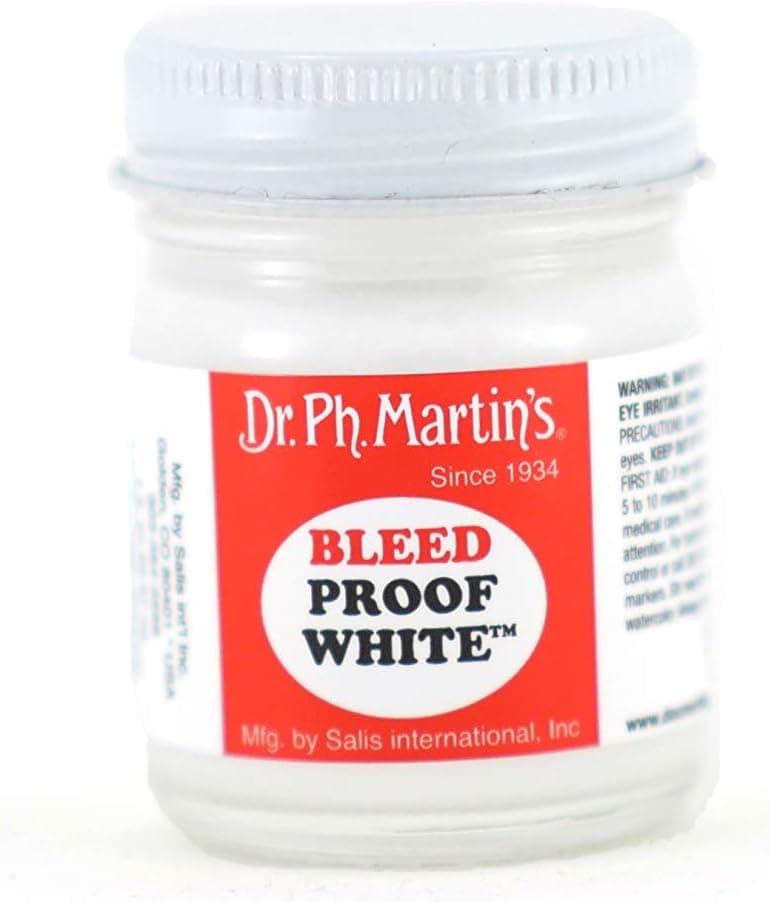
Dr. Ph. Martin's Bleed Proof White in a 1.0 oz jar, the go-to opaque white for pointed pen lettering on dark paper.
Price range: See on Amazon
What we liked
- + Very opaque white covers well on black envelopes and chalkboard-style prints
- + Dilute with a little water for smooth flow through pointed nibs
- + Jar lasts a long time since only a small amount is mixed at a time
Trade-offs
- - Needs mixing to the right thickness, which beginners find fiddly
- - Can dry out in the jar if the lid is left off, so add water to revive it
Who reaches for this white
This jar of Dr. Ph. Martin's Bleed Proof White is the go-to opaque white paint for pointed pen calligraphers who address dark envelopes, letter on black or navy cardstock, or create chalkboard-style lettering pieces. It suits letterers doing wedding stationery, place cards or signage where white text needs to stand out clearly against a dark background, since regular white ink or gel pens often look thin or streaky by comparison. It is less relevant for anyone working exclusively on white or light paper, where a standard black or colored ink covers the same ground without the extra mixing step.
What is in the jar
The product ships as a 1.0 oz glass jar of thick, dense white paint with a wide mouth designed to make dipping a nib in easy. It is technically an opaque watercolor rather than a dye based ink, formulated specifically to cover dark colors, markers and designer colors completely rather than sitting semi-transparently on top of them. Straight from the jar it is quite thick, closer to a paste than a flowing ink, and it dries with a slight sheen. It is explicitly not intended to be mixed with other inks, since doing so can compromise its opacity and flow.
Getting it to flow through a nib
Because the paint comes thick, the main skill in using Bleed Proof White is dilution. Adding water gradually and testing consistency on scrap paper until it flows through a pointed nib without clumping is the standard approach, and most experienced letterers describe this as a bit fiddly at first since too much water reduces opacity while too little clogs the nib. Once diluted correctly, it produces fine, controlled hairlines suitable for Copperplate or Spencerian style scripts even on very dark backgrounds. The jar should be kept sealed between uses, since the paint can dry out if the lid is left off, though it can usually be revived with a little added water.
Trade-offs and how it compares
The learning curve around mixing is the main trade-off, and beginners sometimes need a few practice sessions to find the right thickness before committing to a final piece. Compared with other white calligraphy inks in the same guide, this Dr. Ph. Martin's formula is consistently rated as one of the most opaque and reliable options for covering truly dark surfaces, which is why it remains a standard recommendation even against newer competitors. Its jar size means a small amount lasts a long time, since only a little is mixed at once, making the per-project cost lower than the upfront price might suggest.
Who might prefer a different option
Letterers who want a ready-to-use white ink with no mixing step might prefer a pre-thinned bottled white ink instead, accepting somewhat less opacity in exchange for convenience. For anyone doing serious work on black or dark colored paper where maximum coverage matters, though, this remains the benchmark white in the pointed pen community, and the mixing step becomes routine after a few sessions. Keeping a small dedicated water dropper and mixing dish next to the jar speeds up the process considerably once the right ratio has been found and noted for future sessions, and many letterers jot the ratio down the first time so it does not have to be relearned each time the jar is reopened.
Frequently asked questions
Does Bleed Proof White need to be diluted before use?
Yes, it comes very thick and needs water added gradually until it reaches a smooth, ink-like consistency that will flow through a pointed nib.
Is this paint waterproof once dry?
No, it is described as non-waterproof, so finished pieces should be kept away from moisture or sealed if long-term durability is needed.
Can it be mixed with other inks or colors?
It is not intended for mixing with other inks, since that can affect its opacity and flow characteristics.
What happens if the paint dries out in the jar?
It can often be revived by adding a little water and stirring, though keeping the lid closed between uses helps prevent it from drying out in the first place.
Prices change often, so check the current price and availability on Amazon.
Check price on AmazonCalligraphy Nest may earn a commission from the link above.