PILOT Parallel Calligraphy Pen Set, 1.5mm Nib with Black and Red Ink Cartridges (90050) Review (2026)
Updated September 14, 2026 · Research-based review
Our verdict
The 1.5mm Pilot Parallel Pen is the narrowest in the lineup, a good first pen for practicing italic hand at normal writing size on journals, cards and practice sheets. Its fine width is easy for beginners to control compared with wider nibs, but it shows less dramatic thick and thin contrast and cannot cover larger headings on its own.
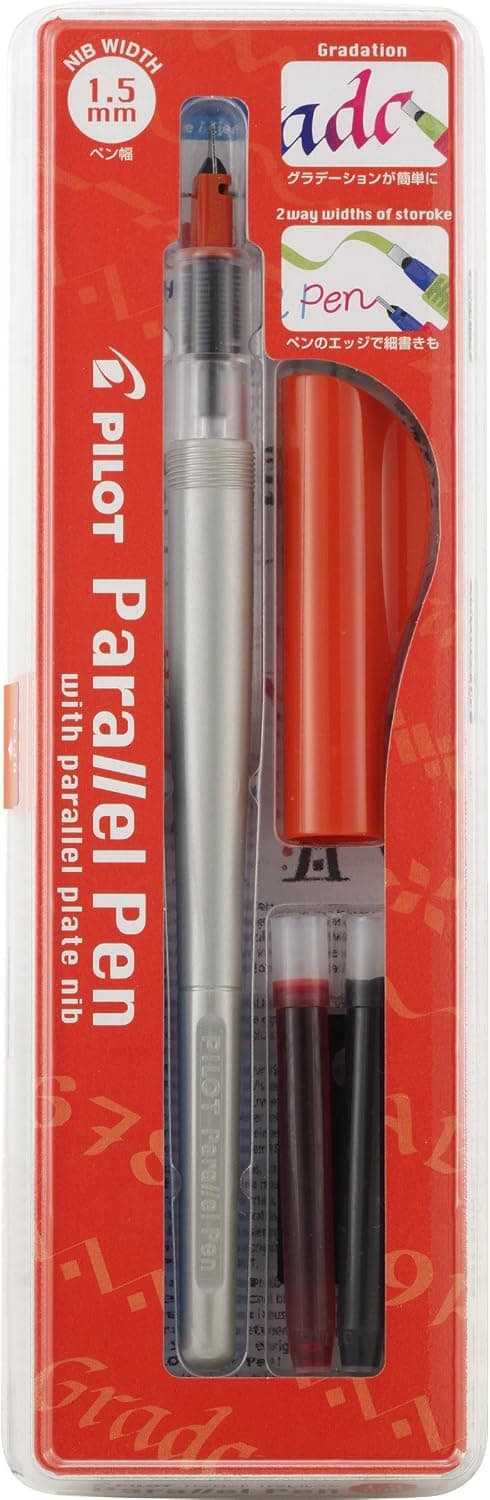
The narrowest Parallel Pen, a good first pen for practising italic hand at normal writing size.
Price range: See on Amazon
What we liked
- + 1.5mm nib suits journaling, cards and practice sheets at everyday size
- + Black and red cartridges included for accent letters
- + Easy for beginners to control compared with wider nibs
Trade-offs
- - Fine width shows less dramatic thick and thin contrast
- - Single size limits you if you want headings later
Who this pen is built for
This is the smallest nib width in Pilot's Parallel Pen range, a 1.5mm stub italic identified by its red cap. It suits people learning italic hand at a size close to normal handwriting, such as journaling, addressing cards, or working through practice sheets, since the narrower nib is easier to control than the wider 2.4mm, 3.8mm or 6.0mm Parallel pens. Beginners who find broad nibs intimidating at first often start here because the letterforms stay closer to a familiar writing scale while still teaching the thick-and-thin stroke discipline of broad-edge calligraphy. It is a weaker fit for anyone whose main goal is large display lettering or bold headings, since a single narrow nib cannot produce that scale on its own.
How the nib and set are put together
Like the rest of the Parallel Pen line, this pen uses a nib built from two parallel metal plates rather than a single slit, a construction Pilot uses to produce sharper, more even lines than either a conventional italic nib or a felt-tip calligraphy marker. The set includes the pen itself, one black and one red ink cartridge, a converter for flushing the nib, a nib cleaner and basic instructions, so a beginner has everything needed to get writing besides paper. One feature shared across the whole Parallel range is the ability to touch the nibs of two Parallel Pens together to blend ink and create gradated color transitions, a trick that works with this 1.5mm pen as well as the wider sizes.
Learning to write with it and keeping it clean
Because the nib is refillable through cartridges, starting is as simple as loading one and priming the flow, and the second red cartridge gives a way to add accent letters or initials without a separate pen. As a beginner-oriented, cartridge-fed design, it avoids the mess of dip pens while still teaching the same broad-edge angle and pressure control used in traditional italic calligraphy. Flushing the nib periodically, especially when switching between the black and red cartridges, keeps the twin metal plates from clogging with dried ink and preserves the crisp stroke edges that make the parallel design worth choosing over a standard italic fountain pen in the first place, using the included converter to draw water through the nib unit.
How it compares with other calligraphy pens
Against Pilot's own four-pen P9005SET, which bundles this 1.5mm nib alongside the 2.4mm, 3.8mm and 6.0mm sizes, buying the 1.5mm alone makes sense for someone who specifically wants to start small and add other widths later rather than paying for sizes they may not use yet. Compared with a Lamy Safari fountain pen fitted with a 1.5mm broad italic nib, a traditional single-slit calligraphy pen at a similar scale, this Parallel Pen's twin-plate nib tends to lay down more consistent ink coverage across the stroke width, while the Lamy offers a more conventional fountain pen feel and grip shape that some beginners find more familiar. Neither alternative changes the core trade-off of this pen: it is a fine, controllable width, not a headline-size tool.
Verdict and who should size up
At our score of 8.3 out of 10, this pen earns its place as an accessible entry point into broad-edge calligraphy, with a scale that keeps early practice manageable and a cartridge system that removes the learning curve of dip pens and ink bottles. Choose it if you are new to calligraphy and want to build fundamentals at an everyday writing size, or if you specifically need a narrow accent pen alongside wider Parallel pens you already own. Choose a wider Parallel Pen, or the full four-pen set, instead if bold headings and display lettering are your main goal, since this 1.5mm nib alone will not produce that scale of stroke.
Frequently asked questions
Is the 1.5mm Parallel Pen good for beginners
Yes, its narrow, everyday writing scale makes it easier to control than the wider Parallel Pen sizes, which is why many letterers use it as their first broad-edge calligraphy pen.
Can this pen be used for large headings or display lettering
Not on its own. At 1.5mm it is the narrowest nib in the Parallel range, so larger lettering projects need one of the wider Parallel Pens, such as the 3.8mm or 6.0mm nibs.
What ink does the pen use and can it be refilled
It ships with one black and one red ink cartridge and is refillable, and like other Parallel Pens it can also take a converter for bottled ink instead of cartridges.
How is this different from a regular fountain pen with an italic nib
The Parallel Pen's nib is built from two parallel metal plates rather than a single slit, which Pilot and retailers describe as giving more even ink distribution and sharper stroke edges than a conventional italic fountain pen nib.
Prices change often, so check the current price and availability on Amazon.
Check price on AmazonCalligraphy Nest may earn a commission from the link above.